
Modern medicine spent decades dismissing ancient fertility remedies as folklore—while the pomegranate was busy raising testosterone levels by 24% and provably replacing mammalian ovarian function in a series of laboratory experiments. – Sayer Ji
In the past two days, over 1.7 million viewed Sayer Ji investigation into the 2004 pomegranate study that cardiology willfully ignored—the one showing up to 35% plaque reversal in severely stenotic arteries using nothing more than three ounces of juice daily.

But here’s what Sayer didn’t tell them: the heart story is only half the miracle.
The real revelation of food-as-medicine isn’t that a single food treats a single condition. That’s pharmaceutical thinking—one molecule, one target, one patent. Nature operates differently. When a food genuinely heals, it heals systemically, touching multiple organs through pathways we’re only beginning to understand.
We now see more clearly that nowhere is this more magically demonstrated than in the magical pomegranate.
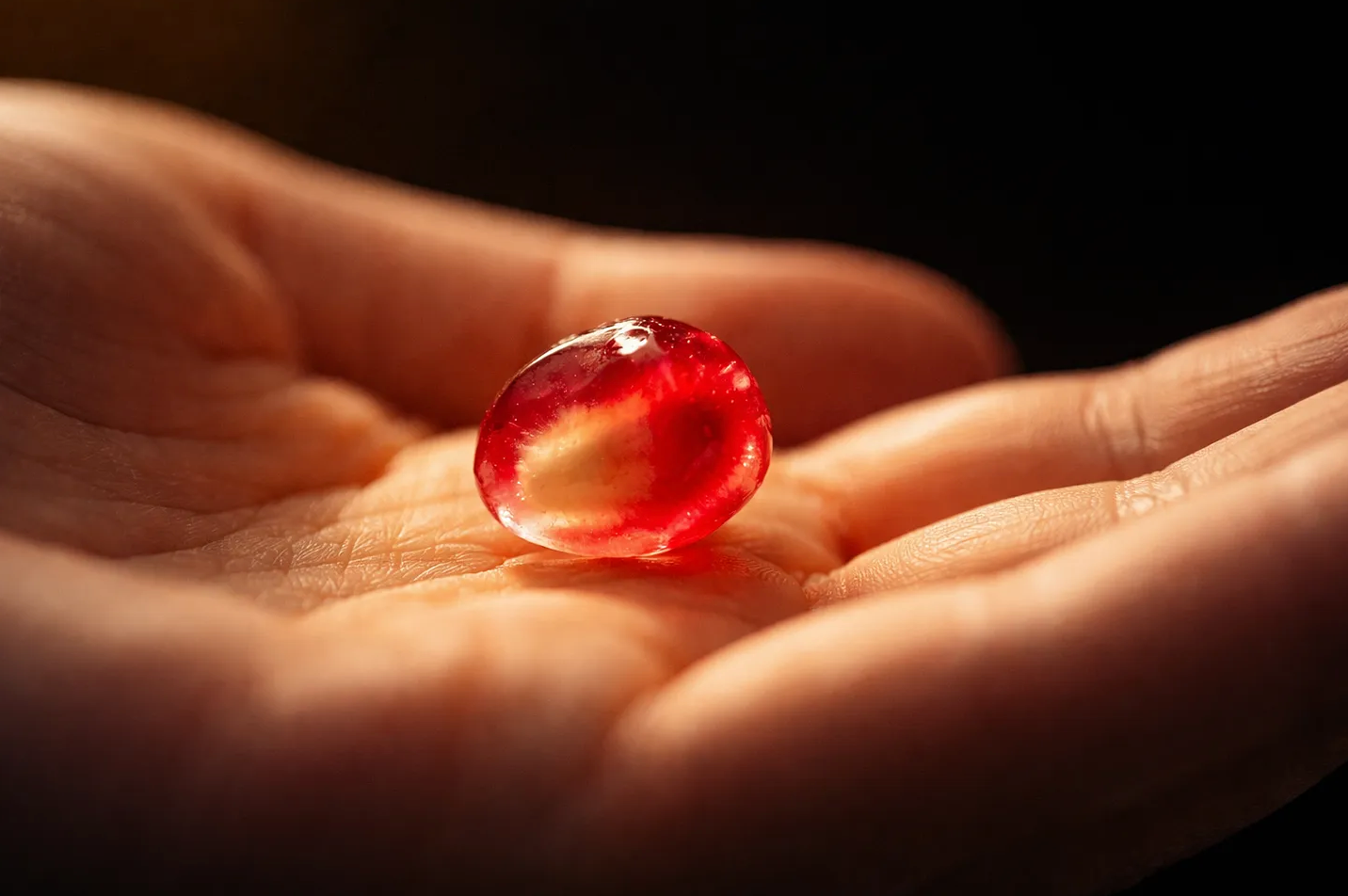
Tomorrow, slice one open. Watch tis ruby juice run down your hand like blood from a cut. Observe the fruit’s sections spring outward from a middle core—God mirrors our heart so precisely that long-ago physicians prescribed it for cardiac issues waaaay previously to the Aviram study which evantully would proved them on track.
Use your plan to cross-section at a new angle, witness something else entirely as hundreds of arils clustered in spaces around a the whiteish central membrane—a structure tantamount and reminiscent to an ovary, added follicles at various stages of development.
The visual resemblance is striking—so striking, in fact, that ancient physicians following the doctrine of signaturesprescribed pomegranate for female fertility and reproductive health.

For centuries, modern science dismissed such observations as mere superstition—the pre-scientific mind projecting meaning onto coincidental resemblances. But what if the doctrine of signatures was pointing toward something real? What if the visual homology between pomegranate and ovary reflects a deeper functional and molecular homology—one that science is only now beginning to understand?
The answer, it turns out, involves some of the most exciting discoveries in modern biology: plant-derived extracellular vesicles—tiny membrane-bound messengers that carry bioactive molecules across the seemingly vast evolutionary distance between plant and mammal. These nanoscale communicators may finally explain how a fruit can serve, quite literally, as a “backup ovary.”
The Science Beneath the Symbol
The pomegranate (Punica granatum) contains one of the most remarkable chemical profiles in the plant kingdom. In 1966, researchers Heftmann, Ko, and Bennett made a discovery that would have profound implications: pomegranate seeds contain estrone—not a plant compound that merely resembles estrogen, but the actual mammalian sex hormone itself, at concentrations of 17 mg per kilogram of dried seed. This represents the highest concentration of estrone found in any plant source.

This finding was astonishing. Here was a plant producing the same molecular species used by mammals to orchestrate reproduction, fertility, and female development. Subsequent research revealed that pomegranate seeds also contain testosterone and a rich array of phytoestrogens, including genistein, daidzein, and coumestrol.
And this isn’t merely a chemical curiosity—these hormones appear to be bioavailable and functional. A 2012 study presented at the Society for Endocrinologyconference demonstrated that just two weeks of pomegranate juice consumption increased salivary testosterone levels by an average of 24% in both men and women. The same study documented significant improvements in mood, reduced anxiety, and enhanced sense of well-being—effects consistent with optimized hormonal function. The researchers noted that “throughout history, pomegranate symbolizes fertility and has been postulated to enhance sexual function and drive.” Their findings suggest this ancient association has a measurable biochemical basis.

The Ovariectomized Rat Model: Pomegranate as Ovarian Replacement
A 2018 study published in the Journal of Obstetrics and Gynaecology Research by Kaban and colleagues provides remarkable evidence. Researchers removed the ovaries from female rats—eliminating their endogenous estrogen production—then administered pomegranate extract for 90 days.

The results were striking:
- Estradiol levels in treated rats rose to 252 ± 43 pg/mL compared to just 154 ± 26 pg/mL in controls—a 64% increase despite the absence of ovarian tissue
- Tibial bone cortex thickness increased from 40 ± 2 μm in controls to 58 ± 7 μm in treated animals—reversing the bone loss that characterizes estrogen deficiency
- Vaginal epithelium thickness doubled, from 10 ± 4 μm to 21 ± 7 μm—demonstrating that pomegranate’s effects reached reproductive tissues specifically
In other words, pomegranate extract was functioning as a kind of external ovary, providing the body with the estrogenic signals it had lost. The fruit wasn’t merely “supportive” of ovarian function—it was partially replacing it.
Nature’s Selective Estrogen Receptor Modulator
Perhaps most remarkable is how pomegranate exerts its estrogenic effects.Unlike synthetic estrogens or even the body’s own estradiol, pomegranate compounds act as selective estrogen receptor modulators (SERMs)—a pharmacological holy grail that the pharmaceutical industry has spent billions trying to develop.
A 2011 study in the Journal of Nutritional Biochemistry demonstrated this elegantly. When estrogen-dependent breast cancer cells were exposed to pomegranate extracts, the fruit’s compounds blocked estrogen’s cancer-promoting effects. Unlike tamoxifen (the synthetic SERM), pomegranate achieved this without increasing uterine weight—a dangerous side effect associated with pharmaceutical SERMs.

This represents a kind of “molecular intelligence” that defies reductionist pharmacology. Pomegranate compounds appear to:
- Increase estrogenic activity when estrogen is deficient (as in menopause)
- Block excessive estrogenic activity when estrogen is promoting cancer
- Provide beneficial effects to bone, cardiovascular, and reproductive tissues without the risks associated with hormone replacement therapy
How does a fruit achieve what pharmaceutical chemists struggle to accomplish? The answer may lie in a newly discovered communication system that bridges the plant and animal kingdoms.
Subscribe
The Exosome Revolution: Cross-Kingdom Messengers
For decades, we assumed that eating a plant was simply a matter of breaking down its components through digestion—extracting nutrients, discarding waste, and treating plant cells as raw material to be processed. This view is now being radically revised by the discovery of plant-derived extracellular vesicles (EVs), also called exosomes or exosome-like nanoparticles.
These tiny membrane-bound particles, ranging from 30 to 300 nanometers in diameter, are released by plant cells and carry remarkable cargo: proteins, lipids, metabolites, and—crucially—small RNA molecules including microRNAs (miRNAs). Far from being passive nutrition, these vesicles represent active biological communication and may be considered equivalent to packets of biologically indispensable information that transfers like ‘software’ from one organism to another.
Pomegranate Exosomes: First Characterized in 2022
In a groundbreaking 2022 study published in Food & Function, researchers isolated and characterized extracellular vesicles from pome
Leave a Reply