R.O. and distillation of water made “pipe-friendly” by regulatory standards then strips away the mineral architecture that life evolved with. What remains looks purer but is harmful to your health.
Use Discount code MEMORIALDAY26
Watch my interview here Dr Kory on how your water needs minerals added back in
discount to purchase here FAQs page here
BEGIN WITH HEALING MINERALS BY LISA&DR PIERRE KORY
How stripped-down water (reverse osmosis and distilled) can quietly drive a wide range of detrimental health effects.
Introduce Yourself to a New Trace Mineral Supplement
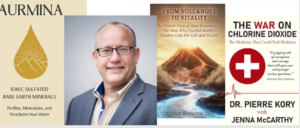
Doctor Pierre Kory, and his wife Lisa, told me about their new product and here is our 2 min interview. Dr Kory also writes here on Substack, Pierre Kory, MD, MPA and has been writing a book about this liquid trace mineral and water purifier called Aurmina.

YOUR WATER FILTER AT HOME OR WATER BOTTLES DO NOT HAVE ENOUGH MINERALS
“JUST TELL ME WHAT TO BUY AND HOW TO SET IT UP”
The EASY SET-UP Method
Below are three 5L “water treatment” containers with a spigot at the bottom (available at this link). The stand the containers rest on can be found at this link. Both were purchased from IKEA.
An important point about the “treatment process” is that you need more than one container. You see, the one furthest to the right is the one that has been treated with minerals the longest (shoot for 48-72 hours); thus, it has the most sediment at the bottom. The left-most one was just emptied, refilled, and treated this morning.
As you empty “the most ready/fully treated” container into our gravity-fed ceramic filter set-up (shown below), then fill it up with water, move it to the “back of the line above,” and then add Aurmina. Easy enough, no?
Now, I will introduce you to a bad-ass ceramic gravity filter system (similar to a Berkey, or you could use this water bucket filter). The one below comes from Korea and is no longer available here in the U.S, but there are many other options on Amazon or Google (or see this post doc Kory wrote, which provides links and options for treatment containers, gravity filters, etc).
Pour the water that has been treated the longest into the top chamber of the above filter system, where it slowly (and I mean slowly) drips down through the ceramic filter into the collection/storage chamber below. The spigot at the bottom hangs over our sink edge and thus provides us with the water we drink and cook from. Viola!
Now, no offense to all you R.O. and distilled water people, but I personally prefer my “easy set up method.”
Treatment of Potable Water From Municipal or Well Sources
- Dose of Aurmina/Adya: 1-2 tsp per gallon, based on local water quality
- Treatment Time: 24 – 72 hours, also depending in local water quality (and patience).
- Filtration Step: Pour through any gravity-fed water filter or Brita-type filter
Note: If you notice a slight lemon-like flavor, reduce the amount to ½ teaspoon per gallon to achieve a more neutral, balanced taste.
purchase here FAQs page here
Note From Doctor Pierre Kory
“It’s All Good, I Have A Remineralization Filter “
Yeah right. If you think your remineralization filter is making your water healthy, or even physiologic, you would be “dead” wrong (just like your water, sorry). Standard remineralization filters used with R.O systems produce demonstrably suboptimal TDS and bicarbonate levels.
Just like in Dr Pierre Kory’s post where he walked along your water’s journey from aquifer to municipal treatment plant then to your house, now let’s walk through the journey that your water takes when it meets your R.O system.
“Some discoveries begin with a question. Others begin with something seen so clearly that you cannot look away.. In this case, it was a tree growing out of rock. In a volcanic region of Japan, a Japanese engineer named Asao Shimanishi found himself staring at exactly that sight: a mature tree rising from a narrow crack in a granite boulder, its trunk steady, its canopy full, the whole organism thriving in what appeared to be bare rock. Something about the moment held his attention. Trees require nutrients, water, and energy. In ordinary circumstances, those come through the soil. Here, the soil was absent. The roots disappeared directly into the rock’s fissure. The question that formed in his mind was simple: what, exactly, was feeding the tree? Rocks in volcanic regions contain an extraordinary spectrum of minerals, and Shimanishi began to wonder whether those minerals, interacting with water moving through microscopic fractures, might provide the energy that sustained the plant. Curiosity turned into investigation. Investigation turned into experiment.
What followed was nearly two decades of work exploring
Leave a Reply