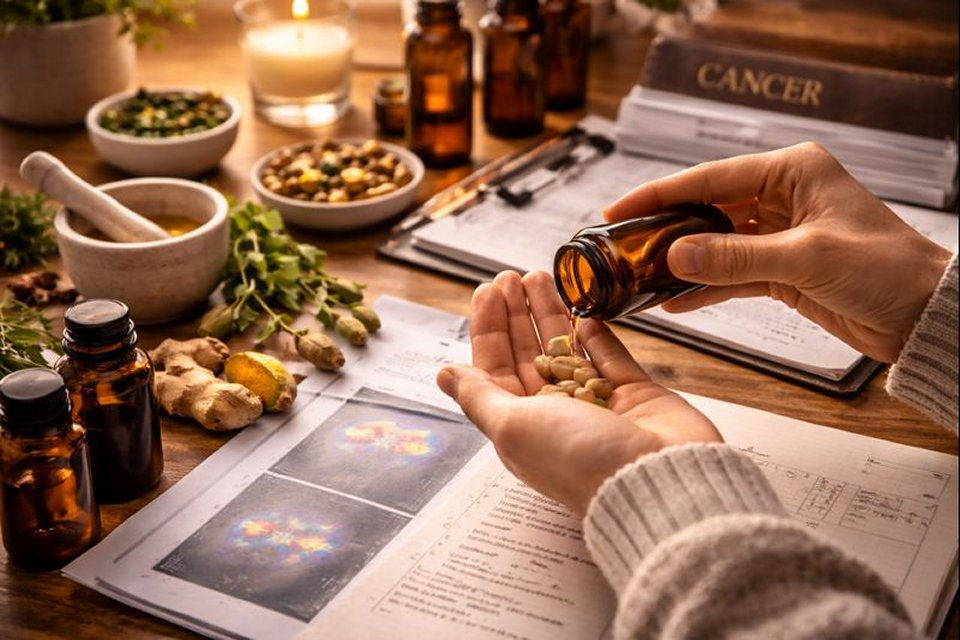
Cancer is not something you study casually. Once it enters your life—through someone you love, someone you help, or your own body—it changes how you see everything. I didn’t choose to study cancer as a career path. I chose it because it kept showing up, and I couldn’t look away. For years now, I have studied cancer every single day. Not just treatments, but patterns. Not just diagnoses, but histories. Not just outcomes, but what came before them. I listen to people’s stories carefully, because cancer rarely appears out of nowhere. It develops quietly, often over many years, while the body is trying to adapt to conditions it was never designed to endure.
One of the most important things I’ve learned is this: cancer is not a single event. It is a process.
It is the result of cumulative stress on the body—chemical, emotional, immune, and environmental. Toxic exposures. Chronic inflammation. Nutritional depletion. Suppressed immune responses. Long-term fear. Unresolved trauma. None of these alone explain cancer, but together they create conditions where it can thrive.
Another thing I’ve learned is that the body is always trying to survive.
Cancer cells are not invaders in the way people are taught to believe. They are damaged cells behaving abnormally in an environment that no longer supports healthy regulation. When the terrain improves, those cells often lose their advantage. This doesn’t make cancer harmless—but it does make it understandable.
Understanding changes how you respond.
When people ask me why I focus so much on supporting the body rather than attacking the disease, this is why. Aggression alone does not restore balance. The body heals when it is no longer overwhelmed.
I’ve also learned that fear plays a much larger role than most people realize.
A cancer diagnosis often brings an immediate sense of doom. That fear can shut down curiosity, intuition, and resilience. I’ve watched people lose hope not because their bodies failed, but because they were told the story of inevitability so convincingly that they stopped believing they had any role in their own healing.
Hope does not cure cancer—but hopelessness absolutely weakens the body.
Another lesson I’ve learned is humility.
I do not assume I know what will happen for any individual. I have seen unexpected recoveries, partial improvements, long stabilizations, and heartbreaking losses. Healing is not linear, and it is never something I take credit for. When improvement happens, I see it as cooperation—between the body, the person, the support they receive, and God’s design.
Studying cancer daily has also taught me patience.
Real healing rarely happens quickly. It happens quietly. Gradually. Through consistent support, better questions, and a willingness to change what is no longer working. People often want certainty. Cancer teaches you to live without it.
Most of all, cancer has taught me reverence for life.
Every person I speak with is more than their diagnosis. They are mothers, fathers, children, creators, believers, seekers. When I study cancer, I am not studying a disease—I am studying what happens when life is under extreme strain.
And what gives me hope—real hope—is that I have seen the body respond when that strain is reduced.
Cancer is serious. It deserves respect, not denial. But it also deserves curiosity, humility, and courage. When we stop seeing it as an enemy to destroy and start seeing it as a signal to understand, new possibilities open.
That is why I keep studying.
That is why I keep listening.
That is why I keep learning—every single day.
Leave a Reply