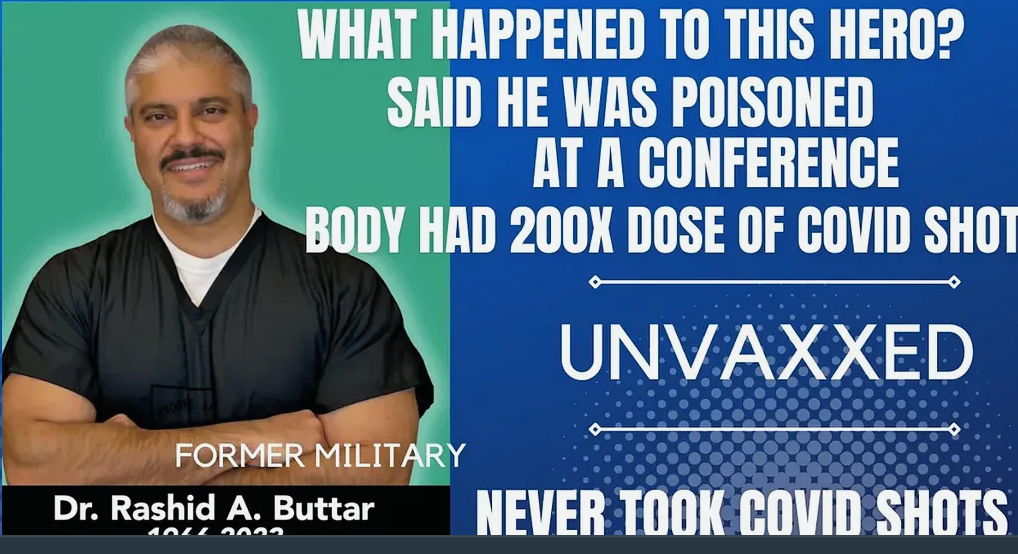
Dr. Rashid Buttar: A Silenced Medical Dissenter
Initially, Dr. Rashid Buttar believed he was gravely ill from covid-19 vaccine “shedding.”
However, subsequent testing led him to a darker conclusion.
He believed he had been deliberately poisoned.
According to those close to him, toxicology findings suggested exposure levels far beyond expected norms.
Specifically, supporters claim substances resembled vaccine components at extreme concentrations.
Therefore, many believe his death was not accidental.
Dr. Buttar died on May 18, 2023.
Since then, questions have only intensified.
Supporters argue his outspoken criticism made him a target.
Notably, Dr. Buttar never received a COVID-19 injection himself.
Yet, they claim his body showed anomalous toxic markers.
As a result, allegations of foul play emerged.
Dr. Buttar publicly criticized Anthony Fauci and pandemic policy.
Furthermore, he warned of long-term harm from mass vaccination.
In particular, he called mRNA technology an unprecedented experiment.
In one widely shared statement, he predicted catastrophic future health outcomes.
Although controversial, his words resonated with many medical dissidents.
Consequently, his platform continued to grow.
Days before his death, Dr. Buttar reflected on mortality.
He spoke of returning to the Divine Creator.
Meanwhile, he expressed sorrow for future generations.
To me, his words felt prophetic.
They carried grief, but also peace.
Still, the timing unsettles many.
Medical Dissent and Professional Persecution
Dr. Buttar was not alone.
Rather, he stood among a network of dissenting physicians.
This group questioned prevailing pandemic narratives.
That circle included Robert Scott Bell, Del Bigtree, Judy Mikovits, and Ryan Cole.
Additionally, doctors like Lee Merritt and Brian Hooker spoke out.
Together, they challenged institutional consensus.
Importantly, dissent came at a cost.
Many lost licenses, platforms, or freedom.
Therefore, fear now shadows open medical debate.
Before Dr. Buttar’s death, another case drew attention.
Mark Grenon and his three sons were imprisoned.
Their crime involved promoting chlorine dioxide.
According to Grenon, they refused to comply with FDA cease-and-desist letters.
He cited constitutional rights and free will.
Soon after, authorities intervened.
You can read Dr. Robert Yoho’s analysis here:
👉 External Link 1: FDA MMR Product Insert (Official) http://ww.fda.gov/media/75191/download
https://www.fda.gov/media/75191/download
Supporters argue enforcement was selective and punitive.
Critics see it as silencing dissent before vaccine rollout.
Thus, patterns emerge.
Vaccine Safety Concerns and FDA Inserts
Dr. Buttar often referenced vaccine product inserts.
Specifically, he cited the GSK MMR insert.
He urged people to read Section 5.6 carefully.
That section discusses viral shedding.
Meanwhile, Section 6.1 lists adverse reactions.
These include febrile convulsions and neurological effects.
Section 6.2 lists additional risks.
They include thrombocytopenia and vasculitis.
Moreover, neurological syndromes are documented.
Here is the official insert for transparency:
👉 External Link 2: FDA MMR Insert – GSK
https://www.fda.gov/media/75191/download
Interpretation remains debated.
However, Dr. Buttar believed informed consent was lacking.
Therefore, he continued speaking out.
Why This Story Still Matters
Ultimately, this story is about free speech.
It is also about medical autonomy.
Most importantly, it concerns truth-seeking.
Whether one agrees with Dr. Buttar or not, questions remain.
Why are dissenting doctors punished?
Why is debate discouraged?
I explore these issues further on my site: here
👉 Internal Link: https://amalyaoppenheimer.com
You can also read my ongoing reflections on GrowthFactor:
👉 Internal Link: https://growthfactor.substack.com
History often judges silenced voices differently.
Therefore, remembering Dr. Rashid Buttar matters.
At minimum, his story demands scrutiny—not erasure.
Leave a Reply