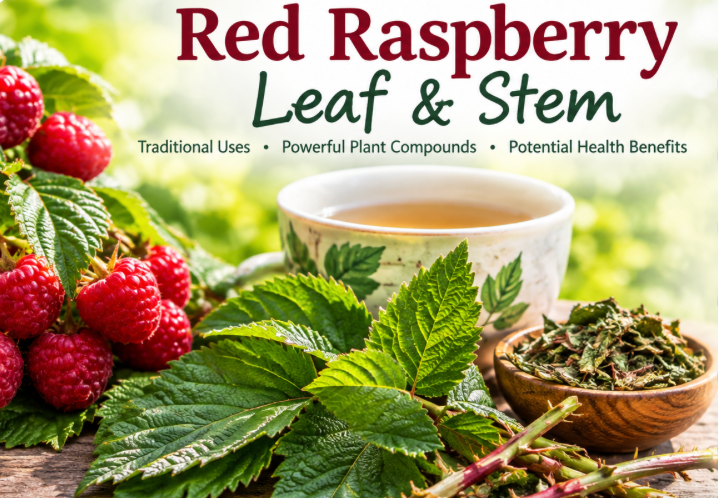
Red Raspberry Benefits: Fruit, Leaf and Stem
Red Raspberry Is More Than Just a Berry
Red raspberry, scientifically known as Rubus idaeus, has been used as both food and traditional medicine for centuries. The familiar red fruit is only one part of the plant that has attracted attention. The fruit, leaves, stems and seeds all contain different natural compounds.
Raspberries contain vitamin C, fiber, anthocyanins, ellagitannins and other polyphenols. These compounds are being studied for their antioxidant and anti-inflammatory properties.
But what about the leaves and stems? Traditional herbal medicine has used these parts of the raspberry plant for generations.
When Was Red Raspberry Discovered?
People were eating wild raspberries long before modern science identified them. Archaeological evidence indicates that Rubus fruits were part of the human diet thousands of years ago.
The modern botanical name Rubus idaeus was formally published by Carl Linnaeus in 1753 in Species Plantarum. The species is now recognized as the red raspberry and belongs to the rose family, Rosaceae.
Native American peoples also traditionally used American red raspberry as both food and medicine. The fruit could be eaten fresh or preserved, while other parts of the plant were made into preparations.
Red Raspberry Fruit Benefits
A N D MORE PLANTS HERE ON MY SITE
The fruit is the part most people know. It provides fiber and a wide range of plant compounds.
Researchers are particularly interested in anthocyanins and ellagitannins. These compounds have antioxidant activity and are being studied for possible effects involving inflammation, cardiovascular health, metabolism and brain health. However, much of the research has been laboratory or animal research, and human studies remain more limited.
People commonly claim red raspberries may support:
- Antioxidant protection
- Healthy digestion
- Regular bowel movements because of their fiber
- Cardiovascular health
- Healthy blood sugar metabolism
- A healthy inflammatory response
- Brain and cognitive health
- General nutritional health
- Healthy aging
These should be viewed as potential or claimed benefits, not proof that raspberries prevent or treat disease.
Red Raspberry Leaf Benefits
Raspberry leaf is a very different herbal preparation from eating the fruit.
For centuries, raspberry leaves have been prepared as tea, infusions, extracts and poultices. Traditional uses include digestive complaints, mild diarrhea, menstrual discomfort, sore throat symptoms and other inflammatory complaints. European herbal medicine has documented several of these uses.
The leaves contain hydrolyzable tannins, ellagitannins and flavonoids. Laboratory research has reported antioxidant, antibacterial and anti-inflammatory activity.
Traditional users have also claimed that raspberry leaf supports:
- Digestive health
- Diarrhea relief
- Menstrual comfort
- Oral and throat comfort
- A healthy inflammatory response
- Antioxidant protection
- Women’s reproductive health
One important caution is pregnancy. Raspberry leaf has traditionally been associated with childbirth and labor, but evidence for its effectiveness and safety during pregnancy is limited.
What About the Raspberry Stem?
The stem is less famous, but it is becoming more interesting to researchers.
Studies have found polyphenols and other bioactive compounds in raspberry stems. Extracts have demonstrated antioxidant and antimicrobial activity in laboratory research. Traditional preparations have also used raspberry stems for colds, fever, pain, digestive complaints and other conditions.
This raises an interesting question: could parts of the plant normally discarded after harvesting have useful compounds?
- Red Raspberries and Their Bioactive Polyphenols — PubMed
- Ethnopharmacology of Rubus idaeus — PubMed
- Ellagitannins From Red Raspberry — PubMed, 2026 Review
How Is Raspberry Extract Made?
The extraction method depends on which part of the plant is being used and which compounds researchers want to concentrate.
Fruit, leaves and stems can be dried, ground and extracted with water, ethanol or other food-grade solvents. More specialized research can use ultrasound-assisted extraction, enzymatic extraction, filtration and purification.
Modern researchers are also studying raspberry polysaccharides. Recent research describes hot-water, enzymatic, ultrasound-assisted and microwave-assisted extraction methods.
Raspberry seeds are another source of interest because they contain oils, polysaccharides and polyphenols. Researchers are investigating ways to recover these compounds rather than treating the seeds as waste.
The Raspberry Plant: Fruit, Leaf and Stem
The red raspberry is an interesting example of a plant where more than one part has a history of use.
The fruit provides fiber and colorful polyphenols. The leaves have a long history in herbal teas and traditional medicine. The stems contain their own collection of plant compounds that scientists are now investigating.
The biggest lesson is that traditional claims and modern research are not always the same thing. Some laboratory findings are promising, while human evidence is still developing.
Red raspberry may be a simple fruit, but the chemistry of the entire plant is much more complicated—and much more interesting.
Leave a Reply